For a few seconds, the noise at Wimbledon softened.
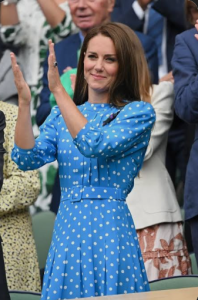
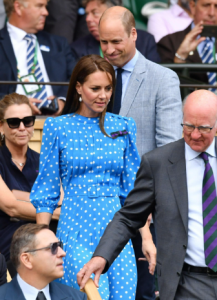
It wasn’t silence exactly—more like a collective pause. The kind that happens when something meaningful enters a space already heavy with tradition. When Princess Catherine, the Princess of Wales, appeared in the stands wearing a graceful polka dot dress, the moment landed with unexpected emotional force. Not because it was dramatic. But because it was
gentle.
And sometimes, gentleness is the most powerful statement of all.
To many Americans watching from across the Atlantic, it may have looked like a simple royal appearance: a beloved figure returning to a familiar place, dressed impeccably, smiling calmly. But to those who have followed Catherine’s journey closely—especially over the past year—this was something far deeper.
This was a return.
A reassurance.
And a quiet declaration of strength.
Wimbledon: More Than a Sporting Event
Wimbledon is not just tennis. It is ritual.
Strawberries and cream. White uniforms. Applause held until the final point. For Catherine, Wimbledon has always been personal. As Patron of the All England Lawn Tennis and Croquet Club, she has long been woven into the fabric of the tournament. But beyond her role, Wimbledon represents continuity—a place where she has shown up year after year, regardless of shifting royal winds.
So when she chose Wimbledon for her comeback, the message felt intentional.
This wasn’t a red carpet.
This wasn’t a state banquet.
This wasn’t spectacle.
This was familiarity.
For Americans, that choice resonates deeply. It mirrors moments we recognize instinctively: the first family dinner after a hard year, the return to a favorite church, the walk back into a place that once felt like home. You don’t go there to be seen—you go there to
breathe.
The Power of the Polka Dot
The dress itself—soft, classic, patterned with polka dots—sparked instant conversation. Fashion commentators dissected the cut. Social media compared it to iconic looks worn by royal women before her.
But to focus only on the dress is to miss the point.
Polka dots have long been associated with timeless femininity. They are playful without being loud. Classic without being severe. They carry nostalgia, but also optimism.
In other words, they suited Catherine perfectly.
At a time when public figures often use fashion to shout, Catherine chose to whisper. The dress didn’t demand attention—it invited warmth. It suggested ease. And after months of absence and uncertainty, ease was exactly what people needed to see.
A Year That Changed Everything
Catherine’s recent withdrawal from public life was not accompanied by drama or oversharing. She did not livestream her struggles. She did not monetize vulnerability. She did not offer constant updates.
She stepped back.
For many Americans accustomed to public figures narrating every hardship, this restraint felt almost old-fashioned. But it also felt deeply dignified.
During her absence, speculation swirled. Questions multiplied. And yet, Catherine remained steady in her silence—protecting her privacy, her children, and her healing.
That silence, once criticized, now reads as strength.
So when she reappeared at Wimbledon, looking composed and present, the emotional reaction was not about relief alone. It was about respect.
She didn’t rush back.
She didn’t explain herself.
She simply returned—when she was ready.
The Crowd’s Reaction: Respect Over Frenzy
Those inside the stands described the atmosphere as different from other royal sightings. There was excitement, yes—but also restraint. Applause felt warmer than louder. Smiles lingered longer.
People sensed this was not a performance.
Catherine wasn’t there to reclaim headlines. She wasn’t there to prove anything. She was there to be.
And that distinction matters—especially to American audiences weary of constant spectacle. In a culture saturated with noise, Catherine’s calm presence felt grounding.
It reminded people of something simple and deeply human: that strength doesn’t always roar. Sometimes it returns quietly, takes its seat, and watches the game.
William, Watching Closely
Observers noted Prince William’s demeanor during the appearance. There was an ease between them—a shared rhythm that suggested months of private resilience.
For Americans who often view royal marriages through tabloid lenses, this moment offered something different. Not drama. Not tension. But partnership.
William didn’t overshadow her.
He didn’t speak for her.
He let her moment stand on its own.
In doing so, he reinforced what many already believe: that the future of the monarchy rests not on dominance, but on balance.
Why This Moment Matters in the U.S.
So why did Catherine’s Wimbledon comeback resonate so strongly with Americans?
Because it taps into values we understand instinctively.
• Recovery without spectacle
• Strength without explanation
• Elegance without excess
In a time when public life often rewards extremes, Catherine’s approach feels almost radical.
She didn’t turn hardship into branding.
She didn’t chase sympathy.
She didn’t rush the narrative.
She lived it privately—and returned publicly with grace.
For many American women especially, that felt validating. It suggested that you don’t owe the world constant access to your pain. That you’re allowed to heal offstage. That when you come back, you don’t need a speech—just presence.
The Unspoken Message
There was no statement issued after Wimbledon. No official commentary. No press conference.
And yet, the message landed clearly.
Catherine is not retreating.
She is not disappearing.
She is recalibrating.
This wasn’t a comeback tour. It was a checkpoint.
A reminder that her role continues—but on terms shaped by wisdom, boundaries, and perspective.
What Comes Next?
Insiders suggest this appearance was not accidental—but it also wasn’t the beginning of a packed public schedule. Instead, it signals something more sustainable.
Selective visibility.
Intentional appearances.
Depth over frequency.
For Americans accustomed to burnout culture, that approach feels refreshing—and aspirational.
Catherine is showing that leadership can evolve. That visibility can be measured. That influence doesn’t require constant exposure.
A Final Reflection
When Princess Catherine sat at Wimbledon, dressed in timeless polka dots, smiling softly as the match unfolded, she wasn’t just watching tennis.
She was modeling something rare.
Composure after challenge.
Grace after uncertainty.
Confidence without noise.
In that moment, she didn’t just return to Wimbledon.
She returned to herself.
And the world—quietly, respectfully—stood ready to welcome her back.
