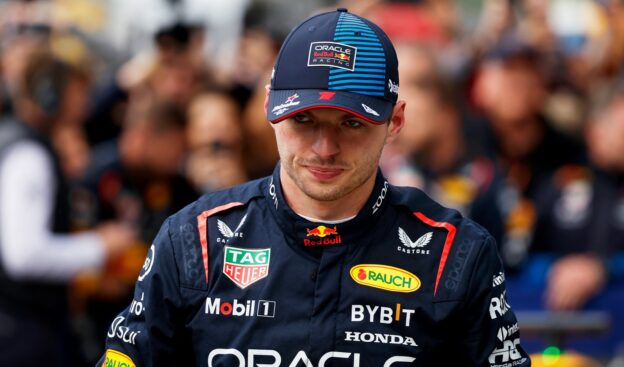
“The Night Max Verstappen Redefined Late-Night Television – Strength Without Raising His Voice”
Jimmy Kimmel’s much-anticipated return to late-night television was supposed to be a celebration – a reboot of the humor, satire, and sharp commentary that made him famous.
Viewers tuned in expecting laughter, controversy, and a bit of late-night chaos.
But instead of comedy, the world watched something far more unforgettable: a moment when quiet strength overpowered sarcasm.
The tension began with a smirk – the kind Kimmel is known for – and a jab directed straight at his guest.
“Max Verstappen, it’s easy to talk about pressure and winning when you’ve basically had the fastest car for four years straight.”
The audience chuckled. It sounded harmless enough. But Max didn’t laugh.
He didn’t avert his eyes.
He didn’t even blink.
His piercingly calm stare held steady, and when he responded, his voice was low and controlled – the voice of a man who has lived through pressure most people will never understand.

“Pressure?
Jimmy, I’ve raced with a car on fire, been crashed into on purpose, and had the entire grid celebrate when I didn’t win.
Don’t tell me don’t understand pressure.”
The silence hit immediately.
Even in a room designed for applause and laughter, there are moments when authenticity cuts through the entertainment and this was one of them.
Kimmel, visibly uncomfortable, tried to salvage the comedic tone with forced laughter.
“Oh, come on, Max. You’re a three-time world champion. Don’t act like you’re some kind of underdog.
You’re just another driver with a silver spoon and a rocket ship.”
It was meant to reset the energy. Instead, it triggered something deeper.
Max didn’t raise his voice. He didn’t flex, boast, or lash out.
He simply leaned forward, the slightest shift that carried the intensity of a driver narrowing into a corner.
“Silver spoon?” he repeated softly.
“I left home at si teen, slept in a trailer, and watched my dad sacrifice everything so I could chase a dream most people said was impossible.
Winning isn’t given, Jimmy.
It’s taken one corner, one lap, one mistake from losing everything at 200 miles an hour.”
The audience erupted.
Standing cheers, whistles, and hollers of “Let’s go, Max!” shook the studio.
The applause wasn’t just enthusiastic – it was cathartic, as if viewers suddenly realized the human beneath the helmet.
Kimmel tried again to regain control, raising his voice over the cheers.
“This is my show, Max!
You don’t get to come in here and turn it into a TED Talk about racing!”
Max remained motionless..
His expression didn’t harden, but it didn’t soften either – it stayed grounded, precise, almost unnervingly composed.
“I’m not giving a TED Talk, Jimmy,” he replied.
“I’m reminding people that real strength isn’t mocking someone from a desk.
It’s getting back in the car after you’ve been taken out on the last lap, smiling for the cameras, and still finding a way to win the next race.
Somewhere along the way, we started confusing sarcasm with intelligence.”
That was the breaking point.

The room exploded into a full standing ovation- fans cheering, some chanting “Mad Max! Mad Max!”
phones held high to capture a moment that clearly wasn’t going to stay within the walls of the studio.
Kimmel sat still not defeated, not angry, simply stunned. His cue cards lay forgotten on the desk.
Then came the moment that turned a powerful exchange into something historic.
Max reached for his glass of water, tapped it lightly on the table, and set it back down.
He looked straight into the camera the same way he has looked down the starting grid for years: unshaken and unafraid.
“This world’s got enough people tearing each other down,” he said.
“Maybe it’s time we started respecting the fight on the track, on this stage, and in life.”
No dramatic exit.
No chest beating.
Just truth- delivered with a champion’s steadiness.
He stood, gave a small, respectful nod to the roaring audience, and walked offstage calm, centered, unapologetically himself.
Then something extraordinary happened.
Without instruction, the band launched into an explosive musical tribute: a high-tempo remix of the Dutch national anthem fused with Formula 1 engine sounds.
The crowd screamed even louder, and the studio once built for punchlines -transformed into an arena.